Happy New Year

Each year during December, some well-meaning people tack on “and Happy Hanukkah” when they say “Merry Christmas.” It’s as if they feel a need to give equal time to their Jewish acquaintances. We hear this a good bit in our Judeo-Christian family, but I also see it other places, such as social media.

But the way to give equal time is to wish Jewish friends “Happy New Year” now.

Rosh Hashanah — ראש השנה — Jewish New Year — begins at sundown today, Sept. 29, 2019, thus beginning year 5780.

For those of us who are Christian, Rosh Hashanah most closely corresponds to Christmas. The Church Year begins with Advent, which prefaces Christmas. But more significantly, there are two High Holidays in each religion. The Most Holy Day in Judaism is Yom Kippur; in Christianity it is Easter. Rosh Hashanah and Christmas are close seconds in importance.

There are Jewish festivals that occur near the times of Christmas and Easter, but — even though Easter has a historic link to Passover — Christmas and Easter are comparable to Rosh Hashanah and Yom Kippur, respectively, rather than Hanukkah and Passover.

Comparing Holy Days with festivals is like comparing apples to oranges. Comparing Holy Days to each other is like grapes to grapes, or ambrosia to ambrosia.

Some thoughts for Trinity Sunday

When Don McLean, in his hit “American Pie,” refers to “the Father, Son and Holy Ghost” as “the three men I admire most,” I suspect many people find that consistent with their own view of the Trinity. There is much that can be said about the anthropomorphic and gender problems with the word “men,” and I am among those who have a problem with those, but that discussion is for another time. I want to look at the number.

I think that most, if not all my Trinitarian friends will easily affirm a belief in One God. Yet the way many talk about the Father, Son and Holy Spirit sounds polytheistic at times. Thus, I can understand why my Unitarian friends can be led to scoff at such a notion.

I ascribe to the doctrine of the Trinity, yet I am a monotheist. Is that possible?

One God in three forms. Is that simple or complex? It seems simple until someone starts talking about the Trinity as “three men” or three seemingly independent beings. Why go out of the way to say “In the name of the Father, the Son and the Holy Spirit” when it’s just one Being?

I saw a program on public TV many years ago that attempted to show how a two-dimensional being (i.e., length and width, but no depth) would experience a three-dimensional one.   As the three-dimensional being passed by, it would appear to the two-dimensional one in changing, two-dimensional forms. The 2-D cannot experience the 3-D any other way.   It has been suggested that our ability – or rather shortcoming thereof – to understand a Triune God is kind of like that. God has more dimensions than we do, thus appearing to us in different forms in different circumstances.  

Countless volumes have been written about the nature of God. I could write a lot of  words in trying to explain what I may understand on this topic at this point in my life, but I’m aiming here for a page, not a book.  Many words and phrases come to mind, including “Creative Force,” “Sustainer of Life,” “Power” and, especially, “Love.”   I grew up hearing the Bible verse “God is love.”   In recent years, I applied the “if A=B, then B=A” logic and have found it helpful to say also “Love is God.” 

And here’s something I don’t believe: I don’t understand God to be some white-haired and -bearded man in a robe sitting in some large chair somewhere up in the clouds.

I’ve always resonated well with the rock song “Jesus Is Just Alright with Me.” I find that I refer to “Jesus” in couple of differing, though related ways. In the past tense, I mean the historical figure who taught us a lot about God and how we should live. In the present tense, I am referring to God as revealed in the teachings and personal example of the historic person. “Christ,” to me, refers to the special and mysterious way in which God was present in the historical man, and to the spirit that he engendered and which lives on today in many people.

I’ll admit I’m a little hazy in distinguishing between “Spirit of Christ” and “Holy Spirit.” But maybe that’s OK, since both refer to God’s presence within us. I think perhaps one distinction may be that “Spirit of Christ” has to do with how we want to live and “Holy Spirit” how we can more nearly do so. Maybe “Christ” is the Love; the “Spirit” is the Power.

I’ve also learned that “Christ” means “God incarnate” – Jesus in the first Century and now the “Body of Christ,” which is the Church – and that the “Holy Spirit” is the “breath of God.” This suggests to me that the doctrine of the Trinity is a reminder that God is living and breathing. That’s helpful to me, as is remembering that “In the name of the Father, the Son and the Holy Spirit” can mean “We honor You in all the ways we experience Your Presence.”

At this moment in my journey, I find that I identify as a Unitarian Jesus freak, empowered by the Holy Spirit.

The Golden Rule reconsidered

Being never-too-old-to-learn, I’ve recently been led to refine my understanding of The Golden Rule. I’ve always interpreted “Do unto others as you would have them do unto you” as “Treat everyone exactly as I want to be treated.”

When I began to hear what I took as challenges to The Golden Rule, my first reaction was, “How could they? This is basic to all major religions. This simple rule is how we could all get along, if we followed it.” When I got out from behind my unnecessary defensiveness, I realized the challenge wasn’t to the rule but to how we often interpret it.

What if someone doesn’t want to be treated the same as I want to be treated?

Some examples that come to mind are almost frivolous, others more serious. If I am offering someone coffee the way I want it, I will not provide them sugar or cream. It’s the way I want it given to me, but I’m not being hospitable. Many people enjoy engaging in trash talk. They give it out, because they like to give and receive such banter. But for some of us, maybe a small few, this interaction is not fun at all. In these incidences, people are treating others as they themselves like to be treated, but it’s not working for the others.

On a deeper level, there are psychological, cultural and physical differences to consider. One example: Say someone is at a stage in the grief process at which he needs some alone time, whereas I, at that same point, would want someone with me. If I insist on hanging close right then, my treatment, though well-intended, isn’t golden.

I still think my old way of looking at it was pretty good, but it falls short. Maybe a better way of looking at it is: I want to be treated a certain way. Doing unto others the same suggests trying, in so far as possible, to understand how others wish to be treated and then treating them that way. We aren’t all wired exactly the same.

Wearing your “Sunday-best”

On Easter Sunday, the newspaper had a feature story on “Sunday-best” clothes. An on-line search reveals that it is a popular topic. It was especially appropriate on Easter because of the tradition of getting and debuting new “church clothes” on that Sunday. The article discussed this tradition, bringing back memories for me.

Our family tradition included picking out our new clothes some weeks before Easter, then putting them on layaway. For any not familiar with the phenomenon, layaway meant the store set the clothes aside for you until you made enough interest-free payments to equal the total cost. This allowed someone on a tight budget to spread the payments over more than one paycheck. Or for those tight-fisted with money, it eased the pain of parting with the whole sum all at once.

In those days, it was important to dress one’s best for church, and a little more so on Easter. That has changed in many circles, notably in those of my experience. I still see some individuals dressing a little better on Easter. I used to have a green sport coat I wore only on Easter — because I got tired of being asked if I’d won the Master’s every time I wore it on any other Sunday. When I got one of those comments even on Easter — to which I’d said, “No, it’s Easter. New life and all” — I stopped wearing it then, too.

I was a young adult, in a church where people wore anything from jeans to suits or dressy dresses, when I realized that one of the negative things about Sunday morning in the past had been the hassle of getting dressed up. And the discomfort of being dressed up. Now I could throw on whatever in a couple of minutes and not be distracted from the spiritual experience by itchy pants or choking ties.

I rarely wear a tie for any occasion. I do wear a sport coat to church and certain other places in the cooler months. It’s not so bad without a tie, plus I like having all the pockets. I generally wear my “dress jeans” — i.e., they are black — and my “dress sneakers” — also black. (I have always hated shoes. I prefer to be barefooted. So I wear the least uncomfortable possible.)

It’s just a personal choice, but I don’t wear shorts to church. I have no problem, though, with others who do. Similarly, I do not wear sports team clothing to church. Some people do. That’s their prerogative.

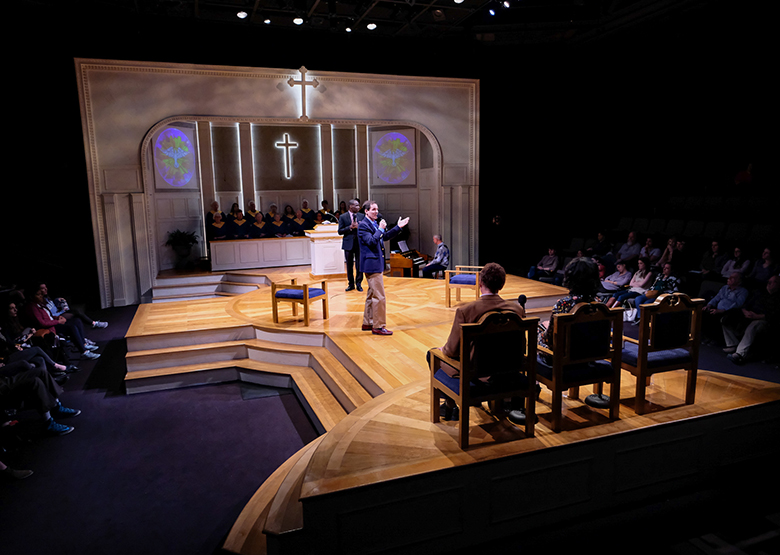
When I appeared as a choir member in a Playmakers Repertory Company production of “The Christians” in early 2018, we wore robes, making pants leg + shoes visible to the audience for only the two or three steps between the stage door and choir loft on our entrance and exit. Our costuming instructions were “Wear church clothes. No jeans or sneakers.”

I was amused, since my church clothes include jeans and sneakers.

Characters as humans

Early in 2018, I was a supporting character in a Playmakers Repertory Company production of “The Christians” by Lucas Hnath. The drama is set in a mega church, complete with choir, which is on stage for about 2/3 of the play. I sang in the choir for 10 performances.

There are five main characters. As created by the playwright and presented by the actors, they are all full-dimension human beings. I found in each things with which to agree and to disagree. All were sincere individuals struggling with their beliefs.

Some people who saw the play missed a lot of what it offered because they chose to see the characters as flat.

The action centers around some changing beliefs about heaven and hell that the church’s pastor shares from the pulpit and the fallout therefrom.

For one friend, generally open-minded about most things, mega church means religious right. He wrote the pastor off as “a Billy Graham,” showing little (or no) interest in what happens to him and those around him. There’s some irony here in that the new theology the pastor espouses is not something Rev. Graham would believe in. Also, Billy Graham was never pastor of a mega church. But such distinctions don’t matter when one deals in stereotypes.

Another friend, who is Jewish, dismissed the whole play with “I’m of another persuasion.” It angered my wife, who also is Jewish, to hear this. This same man, I am sure, would never, ever dismiss a drama about African Americans because he’s not of that race.

The theological themes raised were not issues that only Christians ponder. Further, one doesn’t have to focus on the theological questions. They play works as a study of relationships and personal issues. Some who have little or no use for religion may have tuned out a compelling human drama.

During some performances more than others, there would be those in the audience who would laugh at lines that were not funny. Did they just not get the seriousness of what was going on? Or did they not care to? This was during a time when the pastor is being taken to task. Perhaps some in the audience figured, “I’m glad to see this Billy Graham mocked.” Maybe others, conversely, held on to the conservative view from which this man departed and thus were glad to see him put in his place.

In either case, they were flattening his character and that of the person questioning him.

Playmakers Repertory Company photo.