Forgiveness

If someone wrongs you, then later offers a sincere apology, it can be possible, if not easy to accept the apology and move on – i.e., forgive them.  But what if they never do their part to make things right?   Then you find yourself in the murky area of forgiveness, which seems to be a vast, perplexing area.

Can you forgive someone who doesn’t ask for forgiveness?  Maybe they don’t know or accept that they need it.  Maybe they know but don’t want it.   Would forgiving them absolve them?  

Even with a lifetime of attending church and studying the Bible, plus a master’s degree from a theological school that included training in pastoral counseling, I struggle with understanding “forgiveness.”  I suspect I’m not alone.  

In the Lord’s Prayer, we ask God to forgive us as we forgive those who wrong us.  If we expect God to forgive us, we should be willing to forgive others.  But there are differences between Divine forgiveness and human forgiveness. 

Believers see God’s forgiveness as unconditional, available to anyone who asks for it, regardless of the wrongdoings.  We are absolved of our sins and can start again with a clean slate.

We humans, though, are not divine.   When we attempt to forgive someone, emotional and psychological factors come into play.   We don’t necessarily want to let someone “off the hook.”   Yet the pain someone has caused us won’t go away while we remain angry.  Vengeful thoughts vex only us.  It’s the proverbial drinking of the poison that you intend for the other person.

You have to ask God for forgiveness but can be assured it will be granted.  If you ask another person for forgiveness, it might not be granted.  Also, a person might forgive someone who doesn’t ask for it.  In fact, it can be a good idea to do so, because that can get rid of that poison that is affecting only you.    

That in no way cleans their slate.  That’s not our job, even if it we wanted it to be.  What it does do is take away the power they have over you.  It allows you to recognize the pain you are feeling and to avoid (or stop) letting it define you. This can have a positive effect on your health and peace of mind, whether or not the other person ever understands and accepts that they have wronged you.

It is possible that forgiving someone may lead to understanding and empathy for them.  So much the better if it does, but even if it doesn’t, it’s still worthwhile to forgive, for all the good it can do you. 

What if the person you need to forgive is you yourself?

The health benefits of self-forgiveness are similar to those derived from forgiving others.   Yet, I doubt I’m the only person who sometimes finds it can be more difficult to forgive oneself. 

While getting another person to change is not a goal in forgiving them, self-forgiveness necessarily involves owning your wrongdoing and admitting that you might need to change.  That can be difficult, more so if you aren’t ready to change. 

Sometimes those not ready to change may choose to gloss over their behavior in a sort of artificial self-forgiveness.

Another cautionary note is that even true self-forgiveness can reduce one’s empathy for those they’ve wronged.  Just because you feel better doesn’t mean they do, too.   Experts recommend consciously practicing empathy with those we’ve hurt even as we forgive ourselves for doing so. 

Please note that people who unnecessarily blame themselves for something outside their control are not candidates for self-forgiveness.  They need to work on and let go of their unfounded guilt.   They may also need to forgive someone else. 

I am finding it helpful to identify the anger I feel about certain occurrences. In reflecting on past hurts that linger, I am starting to realize, “Oh, that’s someone I need to forgive.”   I am working toward the next step: in fact forgiving them.

If it’s something about which I am angry at myself, I sometimes remind myself, “That was X years ago.”  Whatever the time frame, I realize that no one else may even remember the incident and, even if someone does remember, it may well not make any difference to them now.  I also have begun to say to myself “It’s OK to make mistakes” or “You are not expected to be perfect” at appropriate times.

Forgiveness, whether of others or oneself, often is difficult. The degree of difficulty may depend on how bad the act hurt or how long the grudge has been held.  It takes work and practice.  Talking with someone, at least a trusted friend if not a professional is often a good idea.

___________________
An internet search for “forgiveness” will yield a plethora of sources. Here are some I consulted:
https://www.gotquestions.org/forgive-forgiven.html
https://www.mayoclinic.org/healthy-lifestyle/adult-health/in-depth/forgiveness/art-20047692
https://greatergood.berkeley.edu/topic/forgiveness/definition#why-practice-forgiveness
https://www.scripturesshare.com/what-is-gods-forgiveness-vs-human-forgiveness/
https://www.verywellmind.com/how-to-forgive-yourself-4583819
https://www.bostonimp.com/post/the-link-between-forgiving-others-and-forgiving-yourself
This analysis of Don Henley’s song, “The Heart of the Matter,” which is about forgiveness, is interesting and may be helpful:
https://melodyinsight.com/don-henley-the-heart-of-the-matter-lyrics-meaning/
Merry and Happy

It’s time for the annual debate: “Merry Christmas” vs “Happy Holidays.” I usually say “Merry Christmas,” though I’m not averse to saying “Happy Holidays,” and I’ve personally never encountered a problem saying “Merry Christmas” to anyone.

There are those, however, who seem to have a problem with one or the other. Some people fall into a conspiracy-theory mode if they hear “Happy Holidays.” Others practically pull a muscle avoiding saying the word “Christmas.” Both can be annoying, though the latter can also be amusing. My wife, who is Jewish, agrees with me. We enjoy joking about holiday trees, the song “The Twelve Days of Holiday,” the poem “The Night Before Holiday,” and Dickens’s classic “A Holiday Carol.”

“Holidays,” it seems to me, has more than one meaning. The word derives from “Holy Days,” days of special religious observance. Christmas is just such a “HolyDay.” Yet we often use the term more broadly. Hanukkah is a religious celebration, but is a festival, not a Holy Day on par with Rosh Hashanah and Yom Kippur. The relatively new Kwanza, is a cultural celebration, based on African harvest festivals. We easily refer to both as holidays.

“Holidays” also connotes days that governments and businesses take off. December 25 and January 1 are designated as such holidays in the U.S. We can wish each other happiness on those two days.

“Holidays” further may mean “when we take vacation days and spend as much time as possible with family.” Thus, “Happy Holidays” here means “enjoy this special period of time and all it includes for you and yours.”

There are 12 days of Christmas. That is NOT because of the song. The song was written because Christmas traditionally ends at Epiphany, Jan. 6. Thus, “Happy Holidays” can be seen as wishing one happiness through the 12 days of Christmas.

For all the reasons listed above, I personally appreciate being wished “Happy Holidays” or “Merry Christmas.” Or any other thoughtful, caring expression.

A million-dollar experience I wouldn’t take $2M to repeat

As the sign came into view, “Entering Forsyth County,” one of my colleagues exclaimed, “Yay, Forsyth County!” It was maybe a little over the top but mostly amusing. She attended Wake Forest University, which is in that county.

There were four of us. Each attended a different college. No one put another’s school down, but none of us hid our pride in our own. This was just another example. It was all in good fun, much more positive than some of our interactions.

We had been chosen and put together for this summer project. Our primary role was to spend a week each in various churches, interacting with youth, leading in worship and presenting two plays. There was one other team like ours. A couple of times, with neither team booked in a church, we were together for other activities.

During one week when we were a group of eight, we had a meeting that departed from the good-natured banter described above.

Seemingly out of nowhere, a guy on the other team criticized me for talking about my school, UNC, and the town in which it is located, Chapel Hill, more than he wanted to hear. My team members, who had spent a lot more time with me, didn’t seem to have a problem with me on this. (But, as we’ll see in a moment, they did have other problems with me.) I tried to say I thought I was joining in the rah-rah banter, maybe as much as but no more than everyone else. If I’d had more presence of mind, I could’ve added that for the past three years, I had spent most of my days there. UNC and Chapel Hill provided the context for much of what I had to say.

He didn’t indicate he had a problem with anyone else sharing their own campus experiences. Ah, but what was different was that he had wanted to go to UNC-CH but couldn’t swing it financially. When others mentioned their schools, he didn’t feel envious.

It was unpleasant, but much worse was to come.

As if interpersonal issues weren’t enough, we also had to deal with a number of external challenges, including a drowning at a swim party and a serious accident during a fellowship event. One day, our supervisor received a letter from members of one church, complaining about our time with them, though the feedback had seemed quite positive while we were there. Late in the summer, we performed the play “In White America” in a town that had just been ordered (finally) to integrate their schools.

Each person had a specific area of responsibility. These roles were team coordinator, music leader, recreation and discussion leader, and preacher. I was designated the preacher and worked up a sermon to give each Sunday. The other guy was assigned recreation and discussion. The older of the two young women was named coordinator, the other given music responsibility.

That seemed good at the start, but circumstances blurred some lines. Because we traveled in my car, it was necessary for me to do some coordinating. Because my guitar and I accompanied our singing in the productions and sometimes in worship, I was de facto music leader at times. Of lesser note, but notable, I was passably athletic while the other male student was not athletic at all. This may have affected our relative roles in some recreational activities.

Even if you don’t intend to usurp some of other people’s authority (and even if they let you), doing so can engender resentment. And I presented them with other issues as well.

I do own some of the blame for intra-team friction. I had strong ideas about many things and could be short on tact. I had mental health difficulties I had only begun to address, though it turned out I wasn’t the only one on the team wearing this tag. Nonetheless, I felt then and still feel now that the amount of criticism leveled at me, as compared to what others received, was excessive.

That I was less conventional in my appearance and approach to life was a problem for the others from the beginning. Yet before the summer started, I had shaved off my then-full beard. I got my hair cut shorter and neater, though since it still touched my ears, it was too long for my teammates. Less superficial were the adaptions I made conversationally. I made sure my language was less “colorful” than was the norm among my college friends. Just as significantly, I began peppering things I said with theological words and phrases, something I had pretty much abandoned as a college student.

I felt I was compromising — moving closer to being like my teammates. I made changes to be less different from them. But I didn’t become exactly like them, and they discredited or disregarded the changes I had made. It wasn’t all; so it was none.

We had a weekly meeting that including the chance to air concerns — i.e., a gripe session. I seemed to be the primary object of the aired concerns. There was one week in which the two females had done something that the other male told me he was going to criticize in that week’s session. But it was held after we’d led some activity in which everything had clicked. My compatriot was in too good a mood to complain during the session. That was the closest we came to having one of those meetings in which I wasn’t the focus.

Things boiled over in a team meeting one night with our supervisor. The other guy on the team went through a long spiel about his growing dissatisfaction. He said he didn’t think he could continue to be on the team. His biggest issue was that there was one person he just could not work with. And that person, he revealed (though everyone already knew), was the person now writing this piece. Among other things, he criticized my hair. That didn’t surprise me, but I was taken aback when he also said the sermon I had preached most Sundays wasn’t any good. That was the first I’d heard of that. Some helpful suggestions early on might’ve been nice.

Before he officially quit, he got a chance for a repeat performance. The next week, we were again together with the other team at a weeklong youth conference. There was a meeting one night of both teams with our supervisor and his supervisor. My colleague repeated his soliloquy for a larger audience, with the same buildup to leveling blame on me. The first time, I had tried to offer some personal defense for my alleged transgressions. This time, I said nothing.

Accommodations were made for us to operate as a team of three in the last two or three churches. Despite this person’s growing resentment toward me, he had freely used me as a sounding board for his personal struggles. Not many days after he had left the team because he couldn’t work with me, he called one morning to the home where I was staying that week, because he just had to talk to me about the latest things with which he was dealing in his personal life.

The summer provided growing experiences, and not all of them were negative. Our highest highs weren’t as high as our lowest lows were low. But there were a lot of highs. Many joyful moments. A lot of intensity, often good, at times not so good. I can’t say I’m sorry I went through it, but by the time it was over, I was more than ready to go home.

After the goodbyes at the conclusion of a meal following the Sunday morning service in our last church of the summer, I got in my car and headed southwest. In Durham, on I-85, I reached the exit with the sign saying:
U.S. 15-501 S
Chapel Hill

Tears flowed.

We relied on the kindness of strangers

It would be our second-longest trip in our 16-year-old VW van. But only if we could complete it.

We — my wife, two daughters, aged 8 and 3, and I — were passing through Pennsylvania on our way to a family wedding in Toronto.

Outside Pittsburgh, we stopped for provisions. As we tried to leave, I had trouble getting the van into gear. After all the years and miles, it could be finicky, but it finally slipped into first and shifted easily as we returned to the highway.

A short hour later, we turned off Interstate 79 at the Lake Arthur exit, where we planned to spend that night. As I slowed to merge onto US 422, I attempted to downshift. The gear shift went to neutral and stayed there. We coasted onto the shoulder. I spent several frustrating minutes trying, without success, to engage any gear.

So, there we were, nearly 500 miles from home, not knowing how, when or if our vehicle would go again. This was not just our transportation. It provided accommodations. We had modified the interior for camping.

The first car we hailed stopped. It was a local couple who gave Nancy, my wife, a ride to the nearest public phone and back. They stopped, they said, because of our North Carolina license plate. They had been involved in an accident while driving through our state a year or so earlier. Several of our citizens had been so kind and helpful during that ordeal, they didn’t hesitate to return the favor.

Nancy checked the Yellow Pages for a tow truck that honored AAA membership. Fortunately, this service was available in nearby Portersville, which was not shown in our Rand McNally Road Atlas.

The owner-driver arrived shortly and hooked up the van. We all piled into his spacious cab. He ran one of two auto-repair shops in Portersville. His specialty was domestic cars. In the meantime, his wife was trying to contact the mechanic who handled the foreign market to see if we could drop the van off at his place. The latter mechanic and his wife were out for the evening, and the babysitter didn’t have the authority to accept the vehicle.

The van spent the night at the domestic-auto repair shop, across the road from the owner’s rural home. The owner’s wife gave us a ride to the local motel, which she had already called on our behalf. She would continue arranging to get the van over to the foreign-car garage.

We took the cooler and a few groceries from the van. Supper was an indoor picnic at the small motel, which sat behind its owners’ home. It was definitely economy class. The black and white TV picked up one channel. But it was adequate, and the charge was $20 for the four of us. Even in 1983, that wasn’t a lot for a motel room. The owners let us use the phone in their house freely the next morning as we talked with both mechanics and looked into the possibility of renting a vehicle to continue our journey.

We walked to a nearby diner for breakfast, after which the foreign-car mechanic’s wife, in their wrecker, picked up the van and then me and took us to their shop — beside their house. Nancy and the girls waited at the motel, unsure when they would see me or the van again. The motel operator graciously extended their stay well beyond check-out time. Nancy volunteered to change our beds in return.

I continued to wonder if we would be back on the road that day and, if so, whether we would be in our van or in a rented car. The foreign-car mechanic was cheerfully optimistic. It was probably just the clutch, he said. No big deal.

I had to wait while he and his son-in-law finished fixing a Datsun. Then I learned that to get to the clutch of a VW van, you have to pull the engine and transmission out. No big deal. They removed both in 10 minutes flat and showed me the pieces of what used to be the clutch. Of course, he had a clutch for a 1967 VW. (Who wouldn’t?) Within an hour, I was ready to roll.

The repair bill was $85, parts and labor. I had paid more than that for a tail pipe at home before the trip. My personal check was fine without accompanying identification.

We were back on I-79 by midafternoon. We decided to drive through to Toronto, no matter how late it got. A campsite awaited us. We wanted to put a lot of distance between us and the trying experience of the preceding 20 hours. Yet we left with warm feelings for all those we encountered. They treated us as guests rather than customers, friends rather than strangers. They were determined, one way or another, to make sure we got out of our predicament with as little distress as possible.

Notes from the beach

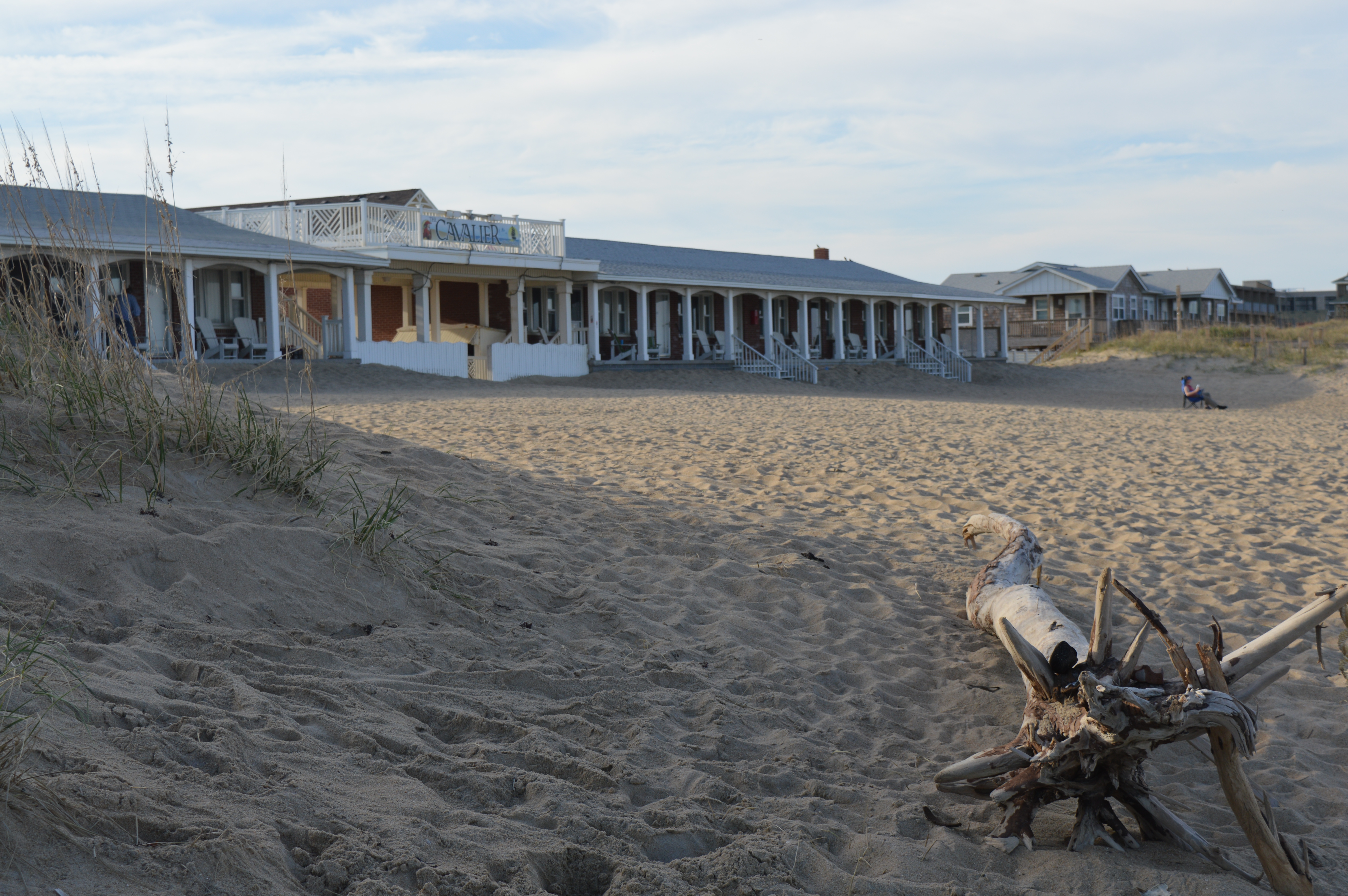
My wife and I recently returned from our annual week at the beach. For four decades, we’ve gone to Kill Devil Hills, NC, site of the first air flights in 1903. At the start, we happened upon the Cavalier Motel — now called Cavalier by the Sea — on the beach road at mile post 8.5, and it has become “our place at the beach.” With the kids, we always went during their spring break. After it was just the two of us again, we shifted to fall.

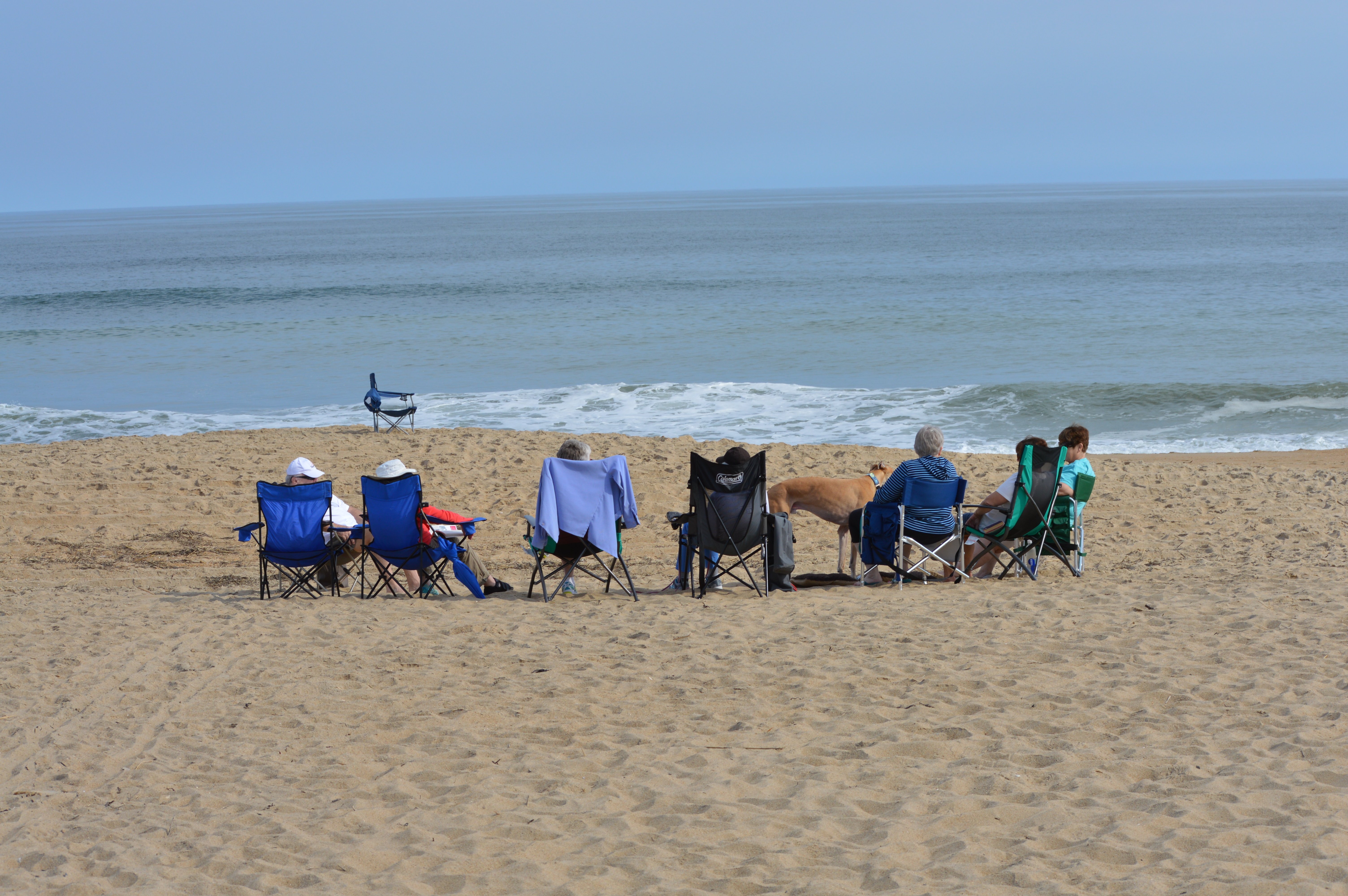
We get an ocean-front room with kitchen. Until a tall building went up next door a few years ago, we could see the Wright Brothers monument out the back window. We share a porch with the other six rooms (two others with kitchens) in the same building. There is an identical building next to us. Depending on the weather, we sit on the beach, the porch or inside, looking at the ocean through our picture window.


This year, I made a few notes and will share them here.

–One day, as I tried to imagine the back story of many of the people walking by, I wondered if other people have similar thoughts while people-watching at the beach. Then I wondered if they ever don’t have such thoughts.

I posed these questions on Facebook: “When you sit on the beach, watching people walk by, do you ever try to imagine their backstories? Do you ever not do this?”

The first two responses led me to realize the questions would best be directed at people with active imaginations, such as writers and story tellers. I ran them by two friends who are bona fide fiction writers. Both said they also sometimes create in their minds stories for people they observe.

–Walking on the beach into a strong wind, bundled up, slipping around in loose sand is a workout. Walking the same beach barefooted and in shirt sleeves, on the terra relatively firma uncovered at low tide is a delightful stroll.

–As always, there were a few kids dipping their feet in the November surf. On one walk, we passed two pre-teen girls doing so. The one with long legs executed a pirouette each time a wave hit her feet and ankles.

–And the dogs are always a delight. You can see them smile as they jump over or into the waves. Golden Retrievers never encounter a person who isn’t their best friend. We also saw one little dog that appeared to about the same dimension in three directions.

–I watched two people in wet suits take their surf boards out into the water to wait hopefully for a wave to ride. I mention this merely to use the word “hopefully” correctly.

–There were two groups of friends there this year while we were. I had two reactions. One was some envy because there have been past years in which we had a group of friends with us. The second was wondering if each group had been in a bubble prior to arriving. They didn’t practice social distancing and no one ever wore a mask.

–One guy was there for a couple of days, one room away from us. He began each day with a cigarette or three, sitting on the porch with a “No Smoking” sign staring him in the face. I wondered how he felt about law and order.

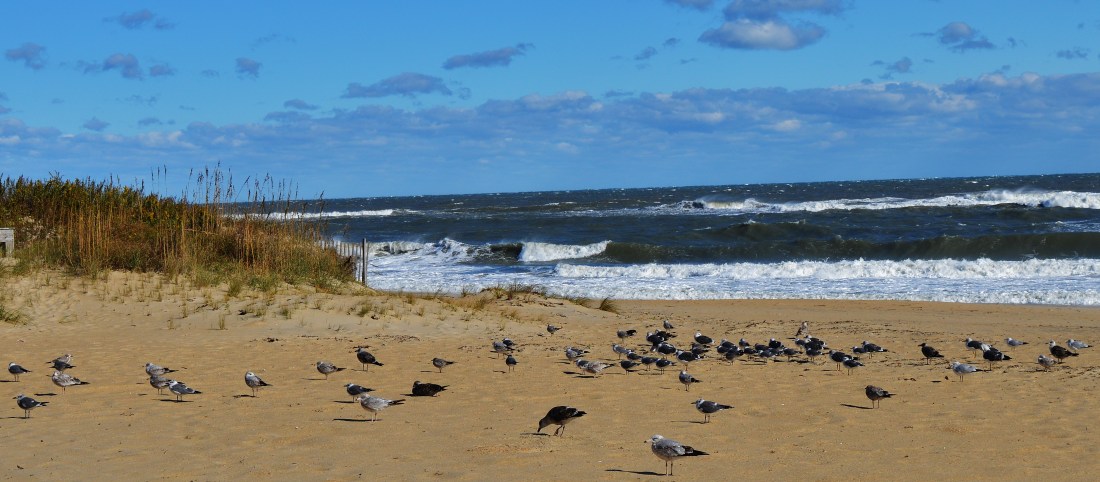
–One afternoon, there were four and twenty black birds, plus quite a few more, on the beach. You usually see just a few here and there among the more numerous seagulls. I don’t know if they were local or just passing through, but when they left altogether, they flew south.


–I took a lot of photos and posted some on Facebook, noting the location. Soon my phone would ask, “How was Cavalier by the Sea?” Was. Past tense. If the phone is so smart, why didn’t it know I was still there?

_________________________________
A year ago, I shared photos of sunrises from the 2019 trip.
https://johnbecton.blog/2019/11/13/five-days-of-beach-sunrises/

Diversity 101

The house my parents bought the year before I was born had a dirt-floored basement, usually called a cellar. Many houses were like that at the time. I think it must’ve been 1956 when we had it concreted. I tend to remember that I was 9. It was summer time.

The man hired to do the work was African American, though that term would come into use decades later. The polite term then was Negro. The derogatory corruption of that word was used by some, though not in our family.

This man brought his son, who was about my age, with him. At first — I don’t remember if it was part/most of one day or parts of two days — the kid just hung around while his father worked. An afternoon rain changed that.

There was a garage-sized space under our front porch. Perhaps it was intended as a garage-without-doors, though we never used it as such. The door into the basement with within that space. Even with our junk, there was plenty of room for the boy to stay reasonably comfortable while sheltered from the rain.

Yet, up in our living room, watching TV with one or more neighborhood friends, my sister and I concluded it was ridiculous for the workman’s son to be under the porch, probably bored out of his mind. She went out and invited him in — with his dad’s permission — to watch TV with us.

He was pretty quiet, but I think there was a little interaction around whatever we were watching. The next day, as my friends and I played, we included him. It was a good fit.

One play-time activity popular with boys my age at that time was to reenact scenes such as those we saw in movies and TV shows about World War II. Armed with toy weapons, we would sometimes track and fight an imaginary enemy. Just as often, we’d divide up into Americans and Germans. One specific memory I have of playing with our visitor was an afternoon in which he and I were on one side versus two boys from the neighborhood.

At first, he and I were the Americans. Later, we switched up, and he and I were the Germans. None of the four of us thought about — and maybe weren’t aware of — the reality that a white soldier and a black soldier would not have been in the same platoon in the U.S. Army in WWII. And we were completely oblivious to the irony of his joining me in portraying German troops. We were just a bunch of typical 7- to 9-year-old boys in the USA, mid-’50s.

At the same time, my parents were having a new, modern tub put in the bathroom. The old one was in the yard awaiting removal. My friends and I had a great time crowding in and pretending it was a boat. Our visitor joined us in this activity as well.

A few days after the concrete job was finished, the workman came back by to make sure all was OK. This time he brought not only his son, but also his wife. I was in the “boat” with one or two other boys when they drove up. Their son hopped out of the car and ran toward us, shouting “Wait for me!” We made room for him to climb in. His parents seemed amused. In the short time his dad was inspecting his work, we kids were zipping along the water in a speed boat.

This was, as I said, 1956. Black people and white people lived in different parts of town. We went to different schools and churches. Opportunities for personal interaction were limited by the way society was structured. Taking advantage of that particular opportunity seemed and proved to be the right thing to do.

Teens stumble upon Christmas spirit

[Excerpted from “Let Nothing You Dismay” in Life Among the Letters: Selected Short Stories by John Becton. ]

By morning three to four more inches of snow had accumulated. There was some melting during the day and refreezing after sunset.

“No wheels tonight,” Bill told George over the phone. “But I’ve got to get out of here. My parents are driving me crazy.”

Each 16-year-old had his allotted share of teen angst.

“Mine too. Let’s go over to Barry’s. He won’t have to get permission to take his own car out.”

Barry had a different idea, however.

“I ain’t taking my baby out in this,” he said. “It was starting to get bad when I came in from work. Let’s just walk over to the bowling alley.” He pulled a heavy gray coat out of the hall closet and called out, “Mom, I’m going over to the bowling alley with George and Bill. We won’t be late.” There was a muffled reaction from upstairs. “No, we’re walking.”

Outside, Barry took in a deep breath, let it out with a satisfied “Ah!” and said, “Well, just a couple more days.” There was no response from his companions.

The bowling alley was over on the main highway, about a 10-minute walk from the Barry’s house. The highway came down a steep hill from the west, leveled at the bowling alley and then became a long, upward grade as it headed east toward downtown. Two cafes, a convenience store and a small office complex had replaced homes along that stretch. The city had recently lined the road with bright street lights.

“This will be like glass before long,” Bill said as he and his companions hurried across the highway and into the building.

“Man, it’s getting colder,” Barry said, stuffing his gloves and toboggan into the pockets of his coat. “Let’s get some coffee.”

Their three cups drained the pot. George took a sip and exclaimed, “Tastes as bad as it smells!”

“I wonder how many hours it’s been sitting there,” Bill wondered aloud. “Well, it least it’s warm.”

The local Top-40 station blared over the PA system. There was a lot of loud talking and laughing, as well as the continual sound of bowling balls crashing into pins.

“There are more people here than I expected,” George noted. He stuck a cigarette in the corner of his mouth and let it flap up and down as he talked. “Lot of locals. See those guys over there? They’re from Westfield High. That’s the problem with living on the edge of town — too close to the farm boys. Probably looking for trouble. They might find it.” He lit the cigarette. “I guess we might as well bowl a game or two.”

“I’m ready.”

“Me, too.”

After Barry picked up a spare, Bill sent his ball down the right side of the lane. He leaned back to his left while watching the ball slip off into the gutter. “Damn thing wouldn’t hook,” he said as he turned around.

George gazed up from the scorer’s table and off to the side. Barry looked at George and then off in the opposite direction. Bill knew what this meant: “We didn’t see it. So it didn’t happen.” He pressed the pick-up button and rolled an official score of 9 for the first frame.

During the seventh frame, they saw the four Westfield students leaving. One looked back, smiled and waved.

By the time Bill, George and Barry had finished bowling, cars heading into town were beginning to slip and slide coming down the hill toward the bowling alley. Even though there was less traffic, crossing the highway would be more of an adventure than before.

“We may never get across,” Barry observed.

Bill motioned toward the now-icy grade that led to downtown. “Look at that.”

Three large trucks were stuck at various spots. One had slid over into the outbound lanes.

“This is getting to be one big mess,” George said. Then he grinned. “Well, we can stand here and watch cars pile up.”

As the boys continued to wait for a chance to cross the highway, a white Chevrolet Bel Aire came across the hill from the west, followed by a red Plymouth Fury. When the cars hit the ice, they slid sideways, bounced off each other obliquely, spun around and collided again.

A third car managed to get around them, but a maroon MG came across the top of the hill too fast and crashed into the Fury. A fifth car clipped the back of the MG and slid off the road. The next one stopped at the top of the hill. Drivers and passengers all got out, apparently uninjured. They began pushing the cars to the side of the road. Even though there were more than enough people, Bill said, “We’d better help.”

“Yeah,” Barry replied. “It’s a good thing we’re here.”

“You two take care of things here,” George said. “I’m gonna stop traffic from coming over the hill.” He trudged up and beyond the top of the hill. He diverted two cars onto a secondary road and stopped a Trailways bus.

“You’ll never get into town this way,” he told the driver. “It’s solid ice on the other side and there are three tractor-trailers blocking the highway on the other hill.”

“You think we can get through these side streets?” the driver asked.

“Yeah. The city buses go that way.”

“What about the conditions?”

“They’ve got snow, but not ice.”

As soon as the wrecked vehicles were out of the way, the car at the top of the hill inched down toward the bowling alley and turned onto the road by the office complex.

George rerouted two more cars, but another refused to stop for his signal. The driver looked straight ahead and kept the wheels spinning steadily toward the top of the hill.

“Son of a bitch!” George yelled, jumping to the side. From the top of the hill, he watched the offending vehicle approach the wrecked cars. The brake lights came on. The car slid into a telephone pole on the left.

“Serves you right,” George muttered. His traffic shift apparently over, he moved on down the hill to examine all the damage. A police car arrived about that time. Before the officer sorted everything out, he got to witness three more fender benders.

“I’ve had about enough of this,” Bill told Barry. “We’ve seen about a dozen cars pile up. It’s getting boring now.”

“Yeah, let’s go. Hey, George, let’s get out of here.”

They cut through the 7-ll parking lot to Mimosa Drive.

“Could you believe the way that Chevy and Fury smacked each other?” George chuckled.

“Man, it was something,” Barry said. He let out a small laugh. “That S-O-B that tried to run over you wrapped around that pole pretty good, didn’t he?”

They didn’t dwell on the subject for long because talking made their teeth hurt. Two blocks down Mimosa, they turned on to Spring Hill Road, which would take them into their neighborhood, just across Parkview Road.

“Man, I’m cold,” Barry said. The other two just nodded. George put his gloved hands into his coat pockets. Bill folded his arms across his chest.

The residential streets had the old, incandescent street lights at three- or four-block intervals. The one at the intersection of Mimosa and Spring Hill was not working. All the houses they passed were dark or dimly lit. There was no traffic. The powdery snow cushioned their footsteps. It was so quiet, it was either serene or deafening, depending on your state of mind.

At the intersection of Spring Hill and Parkview, a white compact car sat silently facing east on Parkview, its right side in the shallow ditch. The boys walked up to the driver’s window.

Behind the wheel was a woman in her late 20s. There were two small children in the back seat. All three occupants looked frightened. The doors were locked.

“Need a push?” George called out.

The woman rolled the window down only a couple of inches. “Oh, yes, thank you. That would be so great, if you could.”

The boys had little trouble getting the car back onto the road. They jogged along behind as it crept around a curve. When the wheels began spinning on the incline by the park, they started pushing again. After a long block, the road leveled.

The car proceeded several yards without their help, then stopped. They walked around to the side. The woman rolled the window more than halfway down. She looked relieved.

“Oh, thank you so much. I think I can make it from here.”

“How far you going?” George asked.

“Malvern Woods.”

“Just a couple of miles and no real hills. Yeah, you should be OK,” Bill said.

She opened her pocket book and reached in. “What do I owe you?”

Each boy stepped back. “Nothing,” Bill said.

“Well, I want to give you something for your trouble.”

“Oh, it was no trouble, really,” George insisted. He started making zig-zagged lines in the snow with the toe of his right boot.

“You were so nice to stop and help. I don’t know what I would’ve done if you fellows hadn’t come along. And you look like you’re really cold. You could be home with your families in your warm houses.”

“No, we’re OK. Just fine,” Barry said. “We’re just glad to help.”

“You just don’t know how much I appreciate it.” She took three one-dollar bills from her pocket book and held them out the window. “Please take this.”

“It really isn’t necessary,” Barry protested. Bill and George shook their heads in agreement.

“I insist.”

The boys didn’t budge.

“Well, here. It’s yours. Merry Christmas.” She threw the bills down in the snow and drove off.

They stood staring at the money.

“I wish she hadn’t done that,” Bill said.

“Me, too,” Barry agreed. “You boys keep it.”

“Nah,” George said. “I don’t want it. You do something with it. Or you, Bill. Put some gas in your Dad’s car.”

Bill just watched snow starting to fall on their reward. Then he looked in the direction the woman had driven away. Then at the tracks the car had made while they were pushing it.

“Boys, this money is just going to get wet,” Barry said. He picked up one of the dollar bills and shook the snow off of it. George and Bill reluctantly did the same.

“I still wish she hadn’t done this,” Bill said.

“Yeah,” George said. “I feel like we owe her.”

Obligatory moon-landing story

I had just graduated from college and was headed to Boston for graduate school in the fall. Part of my existence and a big part of my identity for several years before and after was as a musician. I spent most of that summer performing folk and folk rock at a small club in Augusta GA, Monday-Saturday nights from (I think) 8 or 8:30 p.m. till closing.

By mid-July, I was ready for a short retreat back to Asheville, where my parents and brother still lived in the family home. Saturday closing was at midnight, as opposed to 2 a.m. the rest of the week. On Saturday, July 19, I headed north as soon as my last set ended. I got there at 4 a.m. My brother, eight years older, came in shortly after that from an “all-night” gospel-singing concert in the Asheville City Auditorium.

Apollo 11 was orbiting the moon. It had been only 66 years since the Wright Brothers’ first flights at Kill Devil Hills NC, and yet now three men were flying all the way to the moon. They would land that very day, July 20, 1969.

My life-long friend, Larry Freeman, was living at his grandparents’ house across the street. I had gotten to know him from his frequent visits and some-time residency at their house, beginning as far back as I could remember. He was almost two years older, and by that point enjoying a successful career as a jeweler and watch-repairer.

He came over to visit and watch the moon landing with me. I’m sure that our childhood fantasies, at one time or another, included being spacemen. Now we were 20-somethings having our minds blown by surreal reality.

I was impressed with Neil Armstrong’s cleverness, when he seemed to ad lib the “giant leap for mankind” quip. I was disappointed some years later to learn it was scripted. Nonetheless, it was an impressive event, to say the least.

I was back on stage Monday night. I was refreshed from the short trip. I find myself wanting to say something dramatic such as, But I was a changed person, because the world had changed. Seems a bit over the top, but something was different.

It would take the astronauts a few more days to return to the Earth.