Things you didn’t know I invented

If I were the subject of a Wikipedia page, I would hope it would list three important contributions I have made to modern culture.  I invented the blitz in football, the musical genre folk rock and, in the world of fashion, wash and wear clothing.  At least, as far as I know I did. 

Trying to gasp football’s nuances

I began my very brief interscholastic football career in 1959 as a 7th grader.  The coach put me at linebacker, and I played every defensive down of every game that season. 

The instructions I got on how to play the position and feedback on how I did were limited.  At best.  I did know that linebackers stood up, unlike linemen.  I did understand that the point of defense was to keep the other team from advancing the ball.  I deduced that I should go all out to stuff any attempted advancement as quickly as possible.

So, I did my best to get directly to the ball the moment it was snapped.  I had never heard the word “blitz,” but that’s what I did.  On every single play the whole season.  In later years, I began to hear about blitzing as I followed college and pro football.  I recognized the technique.

Sometimes we switched from a five- to a seven-man line, in which case I dropped into a lineman’s stance.   I still went straight for the ball, but I guess that was not a blitz since I was crouched instead of standing. 

Was louder better?

My first guitar was a Silvertone, a brand produced and sold by Sears for not-a-lot-of-money.  It was your basic acoustic six-string.  As I learned to play and began doing some performing, I wished I could graduate to an electric guitar.  

My playing and singing at that time fell into the folk music category, including a lot of traditional tunes and maybe even more Kingston Trio numbers. 

Eventually, I was able to get an electric guitar.  I continued playing and singing the same songs.  There you had it.  Folk music accompanied on a rock instrument, a few years before Dylan showed up at the Newport Folk Festival with an electric guitar. 

Curating my clothes

Then I invented wash and wear.  Not permanent press.  Wash. And. Wear. 

As I began college, I wore to class clothes we called “Ivy League” style (which later became known as “preppy”), the pants and shirts being clean and pressed.  After classes, I went back to my dorm room, changed and carefully hung the good clothes in the closet.  With such limited wear, each shirt and pair of slacks came up in the rotation a few times in between appropriately spaced trips to the cleaners.   

That was OK for a time.  But was it worth the time (multiple clothing changes each day) and money (cleaners’ fees) to look preppy in class?  I decided it wasn’t.  Following my new plan, I just washed everything, dried it and then wore it.    

Merry and Happy

It’s time for the annual debate: “Merry Christmas” vs “Happy Holidays.” I usually say “Merry Christmas,” though I’m not averse to saying “Happy Holidays,” and I’ve personally never encountered a problem saying “Merry Christmas” to anyone.

There are those, however, who seem to have a problem with one or the other. Some people fall into a conspiracy-theory mode if they hear “Happy Holidays.” Others practically pull a muscle avoiding saying the word “Christmas.” Both can be annoying, though the latter can also be amusing. My wife, who is Jewish, agrees with me. We enjoy joking about holiday trees, the song “The Twelve Days of Holiday,” the poem “The Night Before Holiday,” and Dickens’s classic “A Holiday Carol.”

“Holidays,” it seems to me, has more than one meaning. The word derives from “Holy Days,” days of special religious observance. Christmas is just such a “HolyDay.” Yet we often use the term more broadly. Hanukkah is a religious celebration, but is a festival, not a Holy Day on par with Rosh Hashanah and Yom Kippur. The relatively new Kwanza, is a cultural celebration, based on African harvest festivals. We easily refer to both as holidays.

“Holidays” also connotes days that governments and businesses take off. December 25 and January 1 are designated as such holidays in the U.S. We can wish each other happiness on those two days.

“Holidays” further may mean “when we take vacation days and spend as much time as possible with family.” Thus, “Happy Holidays” here means “enjoy this special period of time and all it includes for you and yours.”

There are 12 days of Christmas. That is NOT because of the song. The song was written because Christmas traditionally ends at Epiphany, Jan. 6. Thus, “Happy Holidays” can be seen as wishing one happiness through the 12 days of Christmas.

For all the reasons listed above, I personally appreciate being wished “Happy Holidays” or “Merry Christmas.” Or any other thoughtful, caring expression.

Beach sunrises

Each year, my wife and I spend a week at the beach. More specifically, at the Cavalier by The Sea motel, milepost 8.5 on the beach road in Kill Devil Hills. We stay in a beachfront efficiency. Until a tall building was built a few years ago, we could see the Wright Brothers monument from our kitchen window.

In my younger days, I would occasionally drag myself from bed to see the sunrise. Now in my not-so-younger days, my biorhythms have changed drastically. Wherever I am, I am up in time to witness the coming of the morning’s light. Thus, for many years, when at the beach, by the time the sun rises, I’ve been out enjoying the colorful preshow for an hour or so.

All photos copyright John W. Becton, 2024

Watching the sun rise provides a lesson in patience. It happens when the Earth rotates far enough. No matter how anxious you are to see it, you can’t make the sun appear a second sooner. Yet, the time of anticipation provides me practice in living in the moment. Each moment leading up to the sunrise can be enjoyed. I find that this approach makes the sunrise itself even more dramatic and fulfilling.

It’s a spiritual experience for me. At the beach, it is also a communal experience. There are others out for the same reason as I. I occasionally speak briefly with one or two and rarely ever know any of them personally. Yet I feel connected to them all.

You have to be attentive. Once that first sliver of light appears, everything happens quickly. The full Sun clears the horizon in a minute or so.

Just as you can’t jump in the same river twice, you see a specific sunrise only once.

That’s nothing

A recent Facebook “memory” was a meme I posted a few years ago that said, “Call me crazy, but I love to see people happy and succeeding. Life is a journey, not a competition.” In the comments, I conjectured, “It could be that personal competitiveness — often manifest as ‘one-upmanship’ — is so embedded in some people’s nature, they are unable to be aware of it.”

I suspect that the roots can be deep.

When I was a child, a common response to another’s boastful statement was, “That’s nothing,” followed by an even bolder claim. We all heard it; we all said it.

—–

“I went fishing yesterday with my dad and caught five fish!”
“That’s nothing. The last time I went, I caught eight. And threw back three little ones.”

—–

“I saw a guy skip a stone on the pond in the park and it bounced seven times!”
“That’s nothing. My brother can make a rock skip 10 times, every time.”

—–

“We drove through six states on vacation.”
“That’s nothing. I’ve been in 15 different states.”

—–

I doubt any of us would learn the term “one-upping” for years, but we seemed to have been born with the ability to practice it. As children, we announced our intention to go-you-one-better with “That’s nothing.” As adults, we’ve matured beyond using that phrase and replaced it with “Yes, but.” You hear it in conversation. You see it on Facebook. Sometimes the “yes, but” is implied, though you can still hear it. If you listen more closely, you hear an echo of “That’s nothing.”

Talk about your current weather experience, and it’s more extreme where they are or recently have been. Travel? They go you one better. Mention something someone did that was stupid and get an example of something even more stupid. Similar if you mention how much — or how little — you just paid for gas. Sometimes an implied “that’s nothing” is pointing out that what you’ve described is good, but less than perfect.

Say something about a personal medical concern and you may well get responses that says, “I have the same problem, only worse and have had it for a longer time.” Anniversary of a parent’s death and you’ll hear from those who encountered this loss even more years ago. Now, in these instances, they may be trying just to be empathetic. Yet the line can be fine between empathy and one-upping. Sometimes the person speaking may not realize which side of that line they are on.

More and more, I’ve amended my comments with the notation that I realize there are more extreme circumstances in other parts of the universe. I’m just commenting on how unusual the temperature, price of gas, or whatever, is for me in my personal realm. “Not trying to start a competition,” I’ve been known to say. Having said all this now, I can’t help wondering if I may be inviting the response, “That’s nothing. I have to endure one-upping comments a lot more than you do.”

Celebrate gates

“Good fences make good neighbors,” according to Robert Frost. I’m not here to dispute that. I have observed, however, that the addition of a gate may make even better neighbors.

When I was growing up, our backyard connected to the backyard of another house. That backyard was completely enclosed by a fence, protecting the flower gardens and other landscaping.

The people who lived there put a lot of work into it, and it was a pleasure to see. They were nice people who exchanged pleasantries across the fence and were fine with visitors. You just had to walk all the way around to the front door (through the yard of either of their next-door neighbors, neither of whom seemed to mind). We rarely if ever did, but we knew we could.

After I had left home, they moved away. My father, often out in his vegetable gardens, got to be good friends with the new owner, who maintained the flower gardens on his side of the fence.

They would talk about mutual interests and point out individual horticultural sources of pride. Sometimes, a closer look was warranted. This involved one or the other walking around the fence on a route that went through our neighbor’s house and his neighbors’ yard.

Eventually, my father told his friend, “If you’ll put a gate in, I’ll pay for it.” I have no trouble imagining a big smile on the neighbor’s face. Soon the gate was there. (I think the neighbor gladly paid for it himself.)

Good fences may indeed make good neighbors, but a gate makes even better neighbors. Or rather, better neighbors add a gate.

Something I’d never worn to my home church before

A few years ago, I wrote about the changes in what people wear when they go to church. As I noted in that post (and as you likely know), when I was growing up, males always wore a coat and tie.

Our church building wasn’t fully air-conditioned in those days. As I recall, a system circulated air freely but didn’t cool it. Since we were in the mountains in a time when the Earth was less heated, this was not a problem except for a few Sundays in the summer.

I remember a congregational business meeting in which the possibility of upgrading the system to cool to full AC was debated. One woman said, “If the men would just leave off their coats in the summer, we wouldn’t need it.” I doubted I was the only one who agreed with her.

In fact, a number of my peers did agree. Eventually, we did something about it. The sermon took up most of the second half of the service. It was preceded by the offertory (passing the collection plates) and a congregational hymn. When I was in high school, some other guys and I decided that at the conclusion of that hymn, we would take off our coats and be more comfortable, sitting for the duration of the sermon.

We got some questioning and maybe less-than-approving looks from adult males. But, in time, many of them were doing the same.

I visited the church of my youth recently. I saw few coats and no ties. I wore my usual “Sunday-go-to-meeting” black jeans and open-neck shirt. That was quite different from how I’d dressed growing up, but I’d dressed similarly for visits in recent years.

I did, however, wear one thing I’d never worn there before. See, it’s been 60 years since I was an adolescent, daring to take off my coat. Thus, for this visit, I wore to that Sunday morning service something my adolescent self never even imagined wearing to church — hearing aids.

A Friday night college experience

One Friday night, early in my senior year in college, I gathered with four other English majors at a bar across the street from campus to wind down after a long week. (The University still had Saturday classes at that time, but some of us had discontinued them for ourselves.)

After a couple of beers, we were about to leave when two professors from our department made an entrance. I’m pretty sure this was not their first stop of the evening. We were in a corner both. They sat down, one on each side, trapping us in.

They proceeded to ply us with more beer while they debated fine points of English literature, which had not been a part of any of our discussion to that point. One was Irish American, complete with red hair. The other was a transplanted Englishman with a commanding presence. The intensity of the discussion grew with each pitcher. It got personal at times. “Castrated Celt!” “Nerd from Northumberland!”

When they finally left, we sat there in a state not unlike shock. One of my friends broke our silence with, “I feel drained.”

We all enjoyed our classes and were serious students. Yet we valued strategic breaks from our studies.

We stumbled out and wandered through campus in a gentle, early-autumn rain. It seemed to be the best way to recover. The rain eased our minds as it slowly penetrated our clothes. That was good enough for most of us. The two females in the group, however, took it a step further. At the construction site of the new student union, they acted on an impulse to roll in the mud.

It didn’t occur to me until decades later to write about the experience. I wonder what the Celt and the Nerd would think of this meager literary attempt. I don’t doubt they would find a way to argue about it.

It wasn’t about coffee

As I noted in a previous entry, I used to post good-grammar reminders on Facebook but stopped nearly a decade ago. Since then, I’ve avoided venting openly, despite regular fingernails-on-the-chalkboard reactions to frequent assaults on our mother tongue on Facebook and elsewhere.


I have tried to demonstrate good grammar in my FB posts and comments. When I could do so without being too obvious, I’ve slipped in a response that followed a rule of grammar violated in the original post.


For example, say the post was, “Today’s sunshine made it a nice day for Zelda and I.” After several other comments, I might enter, “It gave Nancy and me a chance to do some hiking.”


Then, in May of 2018, I came up with another way to demonstrate good grammar subtly. As with the pre-2014 posts, I had no illusions of educating anyone, and my entries most certainly were not directed at any individual. It was just a way to vent. Well, maybe I also wished it might be like hiding a pill in a piece of meat before giving it to a dog.


Unlike in an incident I described in another, unrelated post, I was trying to be “sneaky.” Using colorful backgrounds Facebook offers for short posts, I created a series of memes. The first read, “It’s never too late to have two cups of coffee.” There were a number of “likes” and an enjoyable discussion of the wonders of coffee.


But it wasn’t really about coffee. It was about “too,” “to” and “two.” “It’s never too late to have two cups of coffee.” These are among the homonyms that can confuse some people. This phrase showed all three used correctly.


I created the memes while having my morning coffee. So the invigorating brew was a natural subject. The next two also had coffee as a theme.


The second was “It’s time for coffee to work its magic,” demonstrating a difference between “it’s” and “its.”


(In an English-class assignment during my junior year in high school, I wrote an “it’s” that should have been an “its.” My teacher, one of the best I ever had, circled the error and wrote “Ouch!” in the margin. A teachable moment. Since then, when I see the mistake, I think “Ouch!”)


A few days later, I attacked the often confusing (for some) “you’re” vs. “your” with “Early starts can be difficult, but after a little coffee, you’re on your way.” See? You’re on your way.


In the comments, I was able to add a treatment of “they’re-their-there.” I noted, “Not too difficult, though, because I’m headed to 7 a.m. Bible study. Some don’t have coffee at home before they leave. They’re content to wait to have their first cup there at the church house.” (Italics inserted here.)


And then there’s always the apostrophe. Very useful but often misused. I had already addressed the it’s-its problem. Also troubling is that many people seem to think the letter S must always be preceded by an apostrophe.


The Carolina Hurricanes once had a goalie named Peters. In a Facebook discussion, I saw a fan insert an apostrophe before the last letter of his name. His name! More recently, on a Seinfeld-themed page, someone did the same in a reference to Michael Richards, the actor who played Kramer. “Richard’s” either means “belonging to Richard” or is a contraction of “Richard is” or, occasionally, “Richard has.”


One day I came up with a way to show the apostrophe’s proper use in a possessive and its proper absence from a plural: ” ‘Hey Jude’ was 1968’s top hit and one of the biggest for the 1960s.” It generated some discussion of music and memories associated with that song.


At another time — maybe a couple of times — I’ve posted, “If you visit the Bectons’ home, you may see two or three Bectons, and you might get to hear Daniel Becton’s music.”


I don’t know if the subliminal messages about grammar registered in anyone’s subconscious. I’m sure the number would be between zero and “pretty small.” Likely closer to zero. But in any case, thinking up the posts was fun and a worthwhile mental exercise for me.


Hold onto your hats. Chances are you’re going to see more of these nuggets later in the 2020s. They’re forming in my mind, and I won’t want them to stay there.

Memories of a friend

The word “unique” gets tossed about too casually. Often it is used incorrectly. It means “one of a kind.” Thus the word takes no modifiers. Not “most unique,” “somewhat unique” or “very unique.” Just “unique.” Many times the appropriate word is “distinctive,” which refers to someone or some thing that is quite special and rare, but allows that there may be a few others with similar characteristics.

I am about to tell you about a unique individual.

When I relocated to Chapel Hill in the fall of 1965 to enter the University of North Carolina, I became involved in the Baptist Student Union (BSU). One of the regulars was a guy named Bill Colclough. He was older — how much, I was to learn, was part of a delightful, on-going mythology. He had graduated in some previous year and immediately began working on his master’s degree in summer sessions while teaching school. After completing his graduate degree, he continued taking classes. More on that in a minute.

I think my introduction to the myth came one evening at BSU when we were singing songs from mimeographed sheets. When we got to “Too Old to Cut the Mustard Any More,” it was dedicated to Bill. He smiled appreciatively and waved his arm as if to direct while we sang.

Yet while the myth — enjoyed by no one more than Bill — was that he was ancient, the reality was that he seemed ageless. He was at home in each generation of college student. He seemed never too shocked by current trends and was not judgmental. He was accepting of his friends and genuinely interested in them. I’m sure these qualities contributed to his success as a teacher and guidance counselor.

One memory illustrates his subtle wit and his proclivity not to say anything bad about anyone, as well as his perceptiveness. A past mutual acquaintance, a guy prone to affecting an air of wisdom, came up in a conversation one time. “As I recall,” Bill commented, “he was studying to be an intellectual.”

I witnessed these characteristics through the BSU community for many years. And then there were all those decades of courses.

Sometime, maybe in the early ’90s, I was in a gathering of BSU alums. We were introducing ourselves. I said I graduated in ’69. Others similarly said, ’72, ’80 or whatever their class year was. When it was Bill’s turn, he said slyly, “I graduated in June.” In a sense, though, he was a member of each class.

As long as possible, Bill’s summer break featured attending both summer sessions at UNC. Eventually, the shifting schedule limited him to only one session. He was a little disappointed. After he retired, he moved to fall and spring semesters, taking one class in each. He chose from among courses offered on Tuesday and Thursday, 9 a.m. or later. Most, if not all, were in history, his undergrad major, or English. There are few courses in either department that he never took, and I think that in time he may have revisited some.

Bill attended each year’s graduation ceremonies, as well as other commencement weekend events. One of those was the “Friday Frolic,” at which each reunioning class had its own tent. Bill dropped in to most or all. He once told me about running into a young woman who remembered him from a class or two they had shared. Though she was with her classmates, Bill was the only person there she knew.

This ability to relate to college students continued the rest of his life. In recent years, he had gotten to know some students at his church who eventually made him a member of their fraternity.

Many years into our friendship, Bill told me the actual year he graduated. It would be inappropriate for me to divulge that, but I will say, it was later than the 1910s. Still there is the myth. . . .

One evening in the early ’70s, a group of us were at a UNC baseball game in the then-new Cary Boshamer Stadium. Mr. Boshamer himself was there. When he was recognized, it was noted that he was of the Class of 1917. We all turned and looked at Bill. He smiled, nodded and said, “I remember him well.”

Bill often attended UNC games and various other campus activities. He rarely missed a football or men’s basketball game. I dare say he is the only person who was an enrolled student in the years of all six of the Tar Heels men’s basketball NCAA championships.

My wife and I saw Bill at so many events on campus, we grew to assume he always would be there. That tapered off some in more recent years, but it still seemed that he was always around. It will take time for me to stop assuming he’ll always be there.

Bill’s email address referred to him as “Wild Bill.” This was wonderfully ironic. He was a gentle man, who walked the straight and narrow, albeit with a sharp wit. Each email included a header that said something like: “A message from the past.” The default signature was: “Your best friend, Bill.” I’m sure he intended both to be humorous, though there was a lot of truth in the latter. Taken together, they present the myth and the man.

Famous guests

On rare occasion over the years, I have had a chance to meet someone we would consider “famous.” When I was growing up in West Asheville, we even had “famous” people come to our house, not once but twice.

The first time was when I was about 8 or 9. My father was a veterinarian who worked for the U.S. Department of Agriculture. One evening, an older lady came by our house to get some papers signed. Something about selling some goats.

As soon as she came in, my father walked her to the bookcase and said, “See, we have your husband’s books.” I was confused. Why did we have his books? Had he given them to us? I knew to be seen but not heard and gave the matter little thought for several years.

It was only as a college student, appearing in a production of “The World of Carl Sandburg,” that I realized that had been Mrs. Sandburg at our house. The books were Carl Sandburg’s four-volume “Abraham Lincoln: The War Years.”

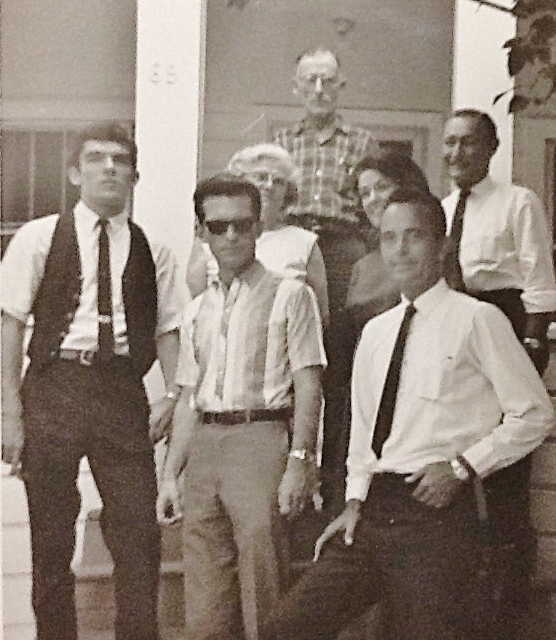
The other celebrity guests visited during the summer after my first year in college. The Chuck Wagon Gang was in town for a concert. My brother Benjamin was active in their fan club. The group was to have dinner at the home of the club’s president, a friend who lived nearby. Benjamin and I were invited to the dinner, and he arranged for the two of us to drive them from the hotel to our friend’s home — by way of a brief stop at our house to say hello to our parents.

Members of the CWG on our front steps with my parents and me (in vest).