
. . . and Happy Hanukkah

Each year, during the time many people wish others “Merry Christmas,” a number of well-meaning individuals (bless their hearts) tack on “and Happy Hanukkah.” Being an inter-faith couple, my wife and I hear this a lot.

Yet these are different celebrations. The primary thing they have in common is that they occur at about the same time of the year.

Christmas is one of two High Holy Days in Christianity, second only to Easter. In this sense, it corresponds to Rosh Hashanah, one of two High Holy Days in Judaism, second only to Yom Kippur. Also, Rosh Hashanah is the Jewish New Year. Advent, which leads into Christmas, marks the beginning of the Church year. So, they correspond in this way, too. Yet my wife hears “Happy Hanukkah” around Christmas time a lot more than “Happy New Year” earlier in the fall.

Yes, there are some common themes shared by Hanukkah and the Christmas season. Since it usually occurs during Advent, our observance of Hanukkah in our home enhances my preparation for Christmas. Yet if the Jewish calendar put some other Jewish holiday, instead of Hanukkah, close to Christmas, I dare say it would be as big as we make Hanukkah to be.

Let me be clear: I am not anti-Hanukkah. It commemorates the rededication of the Temple after it had been defiled by foreign invaders. The word I transliterate here as “Hanukkah” (Jewish sources seem to prefer “Chanukah”) means “dedication.” That’s a significant event. Meditating on faith, freedom, courage, charity, integrity and knowledge is meaningful.

But Hanukkah is not Jewish Christmas. The two are not equivalent. It especially is a shame that some people, who nominally observe one or the other, act as if the two celebrations are in competition. It may be that the “and Happy Hanukkah” phenomenon detracts from the celebration of both Christmas and Hanukkah, while shortchanging Judaism’s two High Holy Days, as well as other lesser holidays and festivals. Further, it can sound a bit patronizing.

What I am advocating here is having reverence for one’s own religious observances and respect for those of others.

I’ve said before, and will likely say again, if you want to balance your “Merry Christmas” for your Jewish acquaintances, notice when Rosh Hashana occurs and wish them “Happy New Year” at that time.

###


Side bar on Passover and Easter

Similar to our December experience, in the spring we have Passover and Easter occurring close together. This likely makes some non-Jewish people more aware of Passover and causes some to want to “give equal time” by tacking on “and Happy Passover.” Yet, again, Easter most closely corresponds to Yom Kippur, in that each is the most High Holy Day of the religion in which it is observed.

A difference from Hanukkah-Christmas, however, is the historic connection between Passover and Easter. During what we Christians call Holy Week, Jesus was in Jerusalem for Passover. The Last Supper of Jesus and his disciples, on which the Eucharist was established, was a Passover seder. This gives the Seder, which I have celebrated each year for decades, special meaning for me.

(It’s worth noting also that in the story told in Luke 2:41-52, in which 12-year-old Jesus goes missing from his parents, who find him in the Temple, they are in Jerusalem for Passover. Thus, two Passover vignettes bookend the story of Jesus’s ministry.)

Passover celebrates the escape of the Hebrew people from slavery in Egypt. It is a highly significant story, told extensively in the early books of the Hebrew Bible. The restoration of the Temple, celebrated at Hanukkah, is also highly significant. This story, however, is recounted in the book of Maccabees, which though included in the Catholic Bible, is not part of the Hebrew Bible (nor that of Protestants
).

###

Lists of Holidays

Hanukkah is but one of many opportunities to offer a Jewish friend acknowledgement of and blessings on a religious observance. Here’s a list of Jewish holidays, major and minor, and the dates on which they occur this year (2025):

Fast of Tevet 10
Sunrise to sunset, Friday, January 10.

15 Shevat
Thursday, February 13.

Purim
Sunset of Thursday, March 13 to nightfall of Friday, March 14.

Passover
Sunset of Saturday, April 12 to nightfall of Sunday, April 20.

Second Passover (Pesach Sheni)
Monday, May 12.

Lag B’Omer
Friday, May 16.

Shavuot
Sunset of Sunday, June 1 to nightfall of Tuesday, June 3.

The Three Weeks
Sunday, July 13, through Sunday, August 3.

The 15th of Av
Saturday, August 9.

Rosh Hashanah
Sunset of Monday, Sept. 22, to nightfall of Wednesday, Sept. 24.

Yom Kippur
Sunset of Wednesday, October 1, to nightfall of Thursday, October 2.

Sukkot
Sunset of Monday, October 6, to nightfall of Monday, October 13.

Shemini Atzeret & Simchat Torah
Sunset of Monday, October 13, to nightfall of Wednesday, October 15.

Chanukah
Sunset of Sunday, December 14, to nightfall of Monday, December 22.

Fast of Tevet 10
Sunrise to nightfall of Tuesday, December 30.


Christian holidays

Here’s a list of Christian holidays, observances, etc. for 2025. I ‘ve heard of most. I don’t even pretend to celebrate a good number of them and don’t really know anyone who does. Some, obviously, are tied to other holidays — e.g., all those associated with Easter, from Ash Wednesday through Easter Monday.

Jan 06, 2025, Epiphany
Jan 12, 2025, The Baptism of Jesus
Feb 02, 2025, Candlemas
Feb 14, 2025, St. Valentine’s Day
Mar 05, 2025, Ash Wednesday
Mar 17, 2025, St. Patrick’s Day
Mar 19, 2025, St. Joseph’s Day
Apr 13, 2025, Palm Sunday
Apr 17, 2025, Maundy (Holy) Thursday
Apr 18, 2025, Good Friday
Apr 20, 2025, Easter
Apr 21, 2025, Easter Monday
Apr 23, 2025, St. George’s Day
May 29, 2025, Ascension of Jesus
Jun 08, 2025, Pentecost
Jun 15, 2025, Trinity Sunday
Jun 19, 2025, Corpus Christi
Jun 29, 2025, Saints Peter and Paul
Jul 15, 2025, Saint Vladimir
Jul 25, 2025, St. James the Great Day
Aug 01, 2025, Lammas
Aug 15, 2025, The Assumption of Mary
Sep 14, 2025, Holy Cross Day
Sep 29, 2025, Michael and All Angels
Oct 31, 2025, All Hallows Eve
Nov 01, 2025, All Saints’ Day
Nov 02, 2025, All Souls’ Day
Nov 23, 2025, Christ the King
Nov 30, 2025, St. Andrew’s Day
Nov 30, 2025, Advent – first Sunday
Dec 06, 2025, St. Nicholas Day
Dec 13, St. Lucia Day
Dec 24, 2025, Christmas Eve
Dec 25, 2025, Christmas
Dec 28, 2025, Holy Innocents
Dec 31, 2025, Watch Night
A million-dollar experience I wouldn’t take $2M to repeat

As the sign came into view, “Entering Forsyth County,” one of my colleagues exclaimed, “Yay, Forsyth County!” It was maybe a little over the top but mostly amusing. She attended Wake Forest University, which is in that county.

There were four of us. Each attended a different college. No one put another’s school down, but none of us hid our pride in our own. This was just another example. It was all in good fun, much more positive than some of our interactions.

We had been chosen and put together for this summer project. Our primary role was to spend a week each in various churches, interacting with youth, leading in worship and presenting two plays. There was one other team like ours. A couple of times, with neither team booked in a church, we were together for other activities.

During one week when we were a group of eight, we had a meeting that departed from the good-natured banter described above.

Seemingly out of nowhere, a guy on the other team criticized me for talking about my school, UNC, and the town in which it is located, Chapel Hill, more than he wanted to hear. My team members, who had spent a lot more time with me, didn’t seem to have a problem with me on this. (But, as we’ll see in a moment, they did have other problems with me.) I tried to say I thought I was joining in the rah-rah banter, maybe as much as but no more than everyone else. If I’d had more presence of mind, I could’ve added that for the past three years, I had spent most of my days there. UNC and Chapel Hill provided the context for much of what I had to say.

He didn’t indicate he had a problem with anyone else sharing their own campus experiences. Ah, but what was different was that he had wanted to go to UNC-CH but couldn’t swing it financially. When others mentioned their schools, he didn’t feel envious.

It was unpleasant, but much worse was to come.

As if interpersonal issues weren’t enough, we also had to deal with a number of external challenges, including a drowning at a swim party and a serious accident during a fellowship event. One day, our supervisor received a letter from members of one church, complaining about our time with them, though the feedback had seemed quite positive while we were there. Late in the summer, we performed the play “In White America” in a town that had just been ordered (finally) to integrate their schools.

Each person had a specific area of responsibility. These roles were team coordinator, music leader, recreation and discussion leader, and preacher. I was designated the preacher and worked up a sermon to give each Sunday. The other guy was assigned recreation and discussion. The older of the two young women was named coordinator, the other given music responsibility.

That seemed good at the start, but circumstances blurred some lines. Because we traveled in my car, it was necessary for me to do some coordinating. Because my guitar and I accompanied our singing in the productions and sometimes in worship, I was de facto music leader at times. Of lesser note, but notable, I was passably athletic while the other male student was not athletic at all. This may have affected our relative roles in some recreational activities.

Even if you don’t intend to usurp some of other people’s authority (and even if they let you), doing so can engender resentment. And I presented them with other issues as well.

I do own some of the blame for intra-team friction. I had strong ideas about many things and could be short on tact. I had mental health difficulties I had only begun to address, though it turned out I wasn’t the only one on the team wearing this tag. Nonetheless, I felt then and still feel now that the amount of criticism leveled at me, as compared to what others received, was excessive.

That I was less conventional in my appearance and approach to life was a problem for the others from the beginning. Yet before the summer started, I had shaved off my then-full beard. I got my hair cut shorter and neater, though since it still touched my ears, it was too long for my teammates. Less superficial were the adaptions I made conversationally. I made sure my language was less “colorful” than was the norm among my college friends. Just as significantly, I began peppering things I said with theological words and phrases, something I had pretty much abandoned as a college student.

I felt I was compromising — moving closer to being like my teammates. I made changes to be less different from them. But I didn’t become exactly like them, and they discredited or disregarded the changes I had made. It wasn’t all; so it was none.

We had a weekly meeting that including the chance to air concerns — i.e., a gripe session. I seemed to be the primary object of the aired concerns. There was one week in which the two females had done something that the other male told me he was going to criticize in that week’s session. But it was held after we’d led some activity in which everything had clicked. My compatriot was in too good a mood to complain during the session. That was the closest we came to having one of those meetings in which I wasn’t the focus.

Things boiled over in a team meeting one night with our supervisor. The other guy on the team went through a long spiel about his growing dissatisfaction. He said he didn’t think he could continue to be on the team. His biggest issue was that there was one person he just could not work with. And that person, he revealed (though everyone already knew), was the person now writing this piece. Among other things, he criticized my hair. That didn’t surprise me, but I was taken aback when he also said the sermon I had preached most Sundays wasn’t any good. That was the first I’d heard of that. Some helpful suggestions early on might’ve been nice.

Before he officially quit, he got a chance for a repeat performance. The next week, we were again together with the other team at a weeklong youth conference. There was a meeting one night of both teams with our supervisor and his supervisor. My colleague repeated his soliloquy for a larger audience, with the same buildup to leveling blame on me. The first time, I had tried to offer some personal defense for my alleged transgressions. This time, I said nothing.

Accommodations were made for us to operate as a team of three in the last two or three churches. Despite this person’s growing resentment toward me, he had freely used me as a sounding board for his personal struggles. Not many days after he had left the team because he couldn’t work with me, he called one morning to the home where I was staying that week, because he just had to talk to me about the latest things with which he was dealing in his personal life.

The summer provided growing experiences, and not all of them were negative. Our highest highs weren’t as high as our lowest lows were low. But there were a lot of highs. Many joyful moments. A lot of intensity, often good, at times not so good. I can’t say I’m sorry I went through it, but by the time it was over, I was more than ready to go home.

After the goodbyes at the conclusion of a meal following the Sunday morning service in our last church of the summer, I got in my car and headed southwest. In Durham, on I-85, I reached the exit with the sign saying:
U.S. 15-501 S
Chapel Hill

Tears flowed.

What it’s like to be a radio personality — for a short time

There was a time when you could hear me on the radio, if you wanted to. And if you were in the same town and had an AM radio. I backed into the experience and rode it as long as it lasted.

My “career” in radio comprised two programs in two different states in which I mixed music and discussion. The first was just for a summer, the second for about two-and-a-half years.

The first was on a small radio station in Orange MA. I say “small” to refer to the size of the staff and building, as well as the reach of its broadcast signal. It was AM, as most stations were back then.

I was in town for that summer, as I had been for the previous one, to run a youth ministry supported by five local churches. For the radio station I checked two boxes: trying to appeal to younger listeners and providing some community-service programming.

As part of the attempt to reach community youth, the Saturday afternoon format was called, at least by the program director, “Rap and Records.” In those days “rap” was slang for “to converse” as a verb or “conversation” as a noun. My shift was referred to as “The United Youth Ministry Portion of Rap and Records.” A friend had a slot in which he played and talked about jazz.

My program aired live for an hour. I had one or two guests. The engineer played a recording of a meaningful rock song I had chosen, and my guests and I discussed it. Listeners could call in and join the conversation, though few did.

I enjoyed hanging around the radio station, getting to know some members of the staff and maybe learning a few things.

The one person on duty during my gig was a high school student who had landed a part-time job there. He used an on-air name that was more Anglo-Saxon than his real name. In time, I learned that another high school student I knew had wanted that job. I had the second guy as a panelist on my show one week. At one point, the student employee called in from another line in the adjacent studio, as if he were a listener at home. During the call, I was aware of some subtle digs between the two, though it’s likely listeners didn’t notice.

At some point, I saw a memo from the program director to the limited number of DJs, who apparently programmed their own music. Selections during the day were to be from the vanilla section of popular tunes — my wording, not his. After sundown, however, “rock out, as long as the towers don’t fall down.” These were his words. The music after dark though, was still pretty vanilla.

One evening I did hear something with a little more zip to it. I don’t remember what it was, but it wasn’t the Carpenters. On the other hand, it wasn’t Black Sabbath either. The D.J. quipped, “I hope the towers don’t fall down,” a reference one could get only if they’d seen the memo.

This same DJ also took credit for the urban legend that Jerry Mathers, TV’s Beaver Cleaver, had been killed in Viet Nam. He told me he and some fellow students had floated the notion on their Westcoast college radio station and it had caught on.

One of the few times my show did get a caller, he had a lot to say about that day’s topic. It was a good interchange, but as the top of the hour approached, I kept trying to end it tactfully. Not only was my segment supposed to end on the hour, but there was also the station identification requirement, about which I somehow was aware. The FCC has loosened up some since then, but in those days, you had to give the station call letters on the hour. There were only two minutes’ grace before you were in trouble.

The clock moved to 2:00 as the guy continued to talk. It moved past as I tried to interrupt without seeming to interrupt. Finally, somewhere between 2:01 and 2:02, he took a breath, I said, “Thanks for calling” and said — through the live phone — “You are listening the WCAT, Orange Massachusetts” with about five seconds to spare. I hung up the phone, quickly wrapped up and tossed it back to the high school student DJ/engineer. I’m sure he had queued up a recorded station break, then probably held it for 3:00.

A couple of years later, after I had returned to Chapel Hill NC, I got to know the program director of the local radio station, then also AM. They had recently expanded their broadcast day to 24 hours. The program director said they needed to expand their public-service broadcasting accordingly.

They were interested in something that could fall into the category “religious programming” but wouldn’t be overtly religious. Canned programs were available, but none really fell into this category. Besides, they preferred something with local appeal. I told him about my previous experience. He agreed I could provide what they needed.

Once again, I featured guests and music. This program, though, was a half hour long. It was prerecorded and aired on Sunday morning. I called it “Sacred Space.” In my introduction each week, I identified it as, “a program dealing with our relationship to God and our relationships with each other, with the belief that these two kinds of relationships are inseparable.” I closed each program with these words: “God touches and is part of all aspects of our lives. Sacred Space is where we stop to realize that.”

Usually, I focused on discussion with the guest(s) and used some music to enhance the discussion. At first, a competent engineer recorded and produced. After he moved on the bigger and better opportunities, the quality of the production help I got began a downward slide. Eventually, I did all the production work myself. My work was at least passable much of the time, though occasionally I ventured into the realm of the Peter Principle.

Every now and then, I deviated from the from the format and offered music and my own commentary. A specific topic may have suggested itself to me. I know I did at least one for Christmas and one inspired by the birth of my first child. A time or two, I threw something together because I had trouble lining up a guest.

I got some feedback from time to time that let me know that at least a few people listened. For a short while, an FM station on a nearby college campus used some of my work in their programming. Running the show itself didn’t work out, but some of my interviews fit into an on-air magazine. (Several years later, I was a guest at that station for an interview — by the same guy who had used parts of my program — to talk about a health promotion program I was running at UNC Health.)

Another commercial station in another city asked about letting them get tapes of “Sacred Space” to broadcast each week, but our PD said no. It was a competitor. Also, the person asking was a former employee of his. While I got along well with both of them, I got the idea they were less than friends.

In time, there was a new program director, with whom I also had a good relationship. At one point, he said he wanted to move my program back from 8 a.m. to 7 a.m. I already wondered how many people were up at 8 on Sunday morning to listen in. I told him I wasn’t sure it was worth my effort to produce a program that even fewer people were likely to hear. He didn’t change the time.

All my work for both stations was volunteer. When I sent tapes to the college FM station, I paid for the postage. Eventually, this PD had the station start cutting me a $5 check (about $30 today) each week for “expenses.” It was basically a “tip” for 3-4 hours of work each week.

I didn’t know it at the time, but that may have been the beginning of the end. Several weeks later, he called me at home one morning and said the station was making some cost-cutting moves. One move was to replace my show with one they could get for free from some organization that was not local. It would begin airing that coming Sunday in my slot.

I had mixed feelings. I was getting tired of doing the program. So, there was some sense of relief, along with the feeling of rejection and some anger at the abrupt way it came down. I choose to remember that the program director at least implied some message of thanks, but I still feel it would have been appropriate for the station’s owner to have sent me a short letter thanking me for all I had done for them. But that wasn’t his style.

My radio days ended without a sign-off.

The Golden Rule reconsidered

Being never-too-old-to-learn, I’ve recently been led to refine my understanding of The Golden Rule. I’ve always interpreted “Do unto others as you would have them do unto you” as “Treat everyone exactly as I want to be treated.”

When I began to hear what I took as challenges to The Golden Rule, my first reaction was, “How could they? This is basic to all major religions. This simple rule is how we could all get along, if we followed it.” When I got out from behind my unnecessary defensiveness, I realized the challenge wasn’t to the rule but to how we often interpret it.

What if someone doesn’t want to be treated the same as I want to be treated?

Some examples that come to mind are almost frivolous, others more serious. If I am offering someone coffee the way I want it, I will not provide them sugar or cream. It’s the way I want it given to me, but I’m not being hospitable. Many people enjoy engaging in trash talk. They give it out, because they like to give and receive such banter. But for some of us, maybe a small few, this interaction is not fun at all. In these incidences, people are treating others as they themselves like to be treated, but it’s not working for the others.

On a deeper level, there are psychological, cultural and physical differences to consider. One example: Say someone is at a stage in the grief process at which he needs some alone time, whereas I, at that same point, would want someone with me. If I insist on hanging close right then, my treatment, though well-intended, isn’t golden.

I still think my old way of looking at it was pretty good, but it falls short. Maybe a better way of looking at it is: I want to be treated a certain way. Doing unto others the same suggests trying, in so far as possible, to understand how others wish to be treated and then treating them that way. We aren’t all wired exactly the same.

Characters as humans

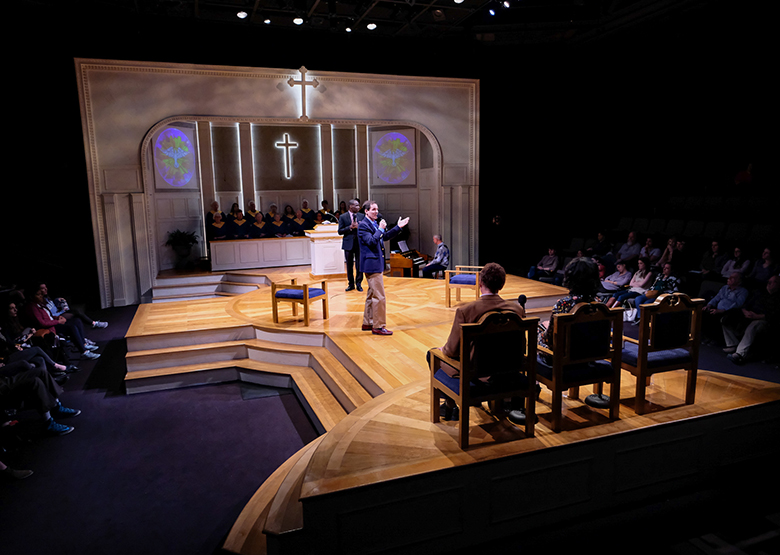
Early in 2018, I was a supporting character in a Playmakers Repertory Company production of “The Christians” by Lucas Hnath. The drama is set in a mega church, complete with choir, which is on stage for about 2/3 of the play. I sang in the choir for 10 performances.

There are five main characters. As created by the playwright and presented by the actors, they are all full-dimension human beings. I found in each things with which to agree and to disagree. All were sincere individuals struggling with their beliefs.

Some people who saw the play missed a lot of what it offered because they chose to see the characters as flat.

The action centers around some changing beliefs about heaven and hell that the church’s pastor shares from the pulpit and the fallout therefrom.

For one friend, generally open-minded about most things, mega church means religious right. He wrote the pastor off as “a Billy Graham,” showing little (or no) interest in what happens to him and those around him. There’s some irony here in that the new theology the pastor espouses is not something Rev. Graham would believe in. Also, Billy Graham was never pastor of a mega church. But such distinctions don’t matter when one deals in stereotypes.

Another friend, who is Jewish, dismissed the whole play with “I’m of another persuasion.” It angered my wife, who also is Jewish, to hear this. This same man, I am sure, would never, ever dismiss a drama about African Americans because he’s not of that race.

The theological themes raised were not issues that only Christians ponder. Further, one doesn’t have to focus on the theological questions. They play works as a study of relationships and personal issues. Some who have little or no use for religion may have tuned out a compelling human drama.

During some performances more than others, there would be those in the audience who would laugh at lines that were not funny. Did they just not get the seriousness of what was going on? Or did they not care to? This was during a time when the pastor is being taken to task. Perhaps some in the audience figured, “I’m glad to see this Billy Graham mocked.” Maybe others, conversely, held on to the conservative view from which this man departed and thus were glad to see him put in his place.

In either case, they were flattening his character and that of the person questioning him.

Playmakers Repertory Company photo.